
SIM Spotlight: Douglas Scherer
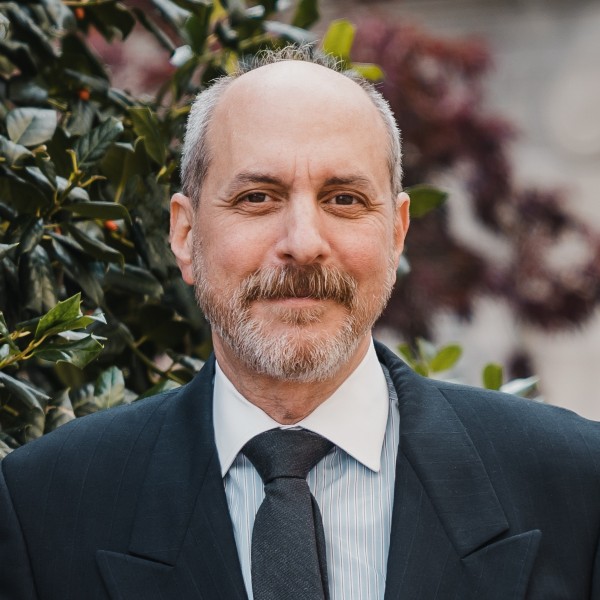
Doug Scherer’s career has moved across disciplines withunusual range, from musicology and information science to enterprise technology leadership, executive coaching, and leadership research. Along the way, he developed a perspective shaped less by technology alone and more by the human side of leadership: decision-making, resilience, communication, and growth under pressure.
In the conversation below, Scherer reflects on the experiences, mentors, risks, andleadership lessons that shaped his path, in his own words.
Background & Motivation
It actually started in music. I was researching musicology and I got exposed to information systems. That led me to pursue a master’s degree in information science, and then a certificate in data design and analysis. Over time my career evolved into IT leadership roles. As I began consulting across different industries, something became very clear: the hardest problems aren’t technical. They are about how people work together, make decisions, and navigate change. I became more and more interested in leadership development, which wound up shaping my doctoral research on leadership as a skill set and a life journey.
Influence & Mentorship
I’ve had some amazing mentors at very different points in my life. One of the earliest was a teacher of mine at the Eastman School of Music.He once told me a story about touring Europe as a young soloist, when a famous conductor gave him this guidance about music interpretation: “You don’t really know the line of bad taste until you’ve crossed it.” That idea stayed with me. As a world-class musician, he pushed boundaries of music interpretation. In leadership, I align that with taking risks and the importance of avoiding perfection paralysis.
Later in my career, two incredibly influential mentors in the IT field were Dr. Arthur Langer, a former SIM Board member, and Peter Koletzke, an Oracle guru and prolific author. I studied with them while earning my data design certificate at Columbia University, and over time they became lifelong friends and colleagues. One of the most important lessons they taught me early on was the importance of seeing new technology through the client’s business and strategic lens. They also led me into the discipline of writing, public speaking, and teaching, including lecturing and chairing certificate programs, which ended up shaping how I lead and communicate today.
Strategic Scope
Think of what it’s like to be in the heat of developing strategy. You might thrive on the challenge, and you might feel the pressures of time and the weight of others’ expectations. My work translates research, real-world experience, and personal resilience, including lessons from recovering from spine surgery, into practical leadership insights to support your strategic thinking, open mindset, and burnout. Interviewing executive leaders for my dissertation and my book F.O.R.G.E.D. was pivotal in defining my path. I was continually impressed by how openly leaders shared their experiences, often extending brief meetings into deep, meaningful conversations. It reinforced that we’re all in this leadership journey together.
Efficiency
Moments for Grounding. It’s a battle for me to move my behind out of my chair. But once I do, clarity and energy return. Senior leaders need to move. Too many hours back-to-back in simultaneous Zoom sessions and juggling multiple active chats can leave our minds scattered. Human minds don’t multitask, they task shift. Taking time to get up and move, and to be more embodied rather than purely conceptual, is a non-negotiable for my focus and productivity.
Growth
I learn by doing and by sharing what I learned through my work. Even though I think of myself as shy, I get energized when I get up to speak, engage, and help others grow. To make that happen, I have to prepare, research, and refine. When you teach something, you have to learn it so well that you can translate it to others. To stay current, I suggest using approaches like reading, networking, or something else so you can clearly share what you’ve learned.
Leadership Evolution
For innovative, high-performing organizations, I’ve found that what really drives results is an individual and organizational learning mindset. This allows people to design and own their decisions, their successes, and their failures. One of my pet peeves is micro-management. When you see organizations motivated through micro-management, you can be almost certain they are fear-based and less innovative. As a leader, you’re probably looking for the highest intersection of productivity and creativity. One of your fastest and best ways to get there is by fostering a true learning culture.
Team & Culture
This question could be an entire book, so I’ll offer just one core concept. Alignment yields engagement. Yes, you can try and even succeed in forcing your agenda on others, but it will be a one-off, hollow success. You will get far more productivity, participation, motivation, and future cooperation when you understand and support their agenda as well.
Reflection & Advice
I’d say, be open to the full journey, not just the skills you studied. I did not start in IT leadership. I began in data design and analysis and assumed it would be a linear career path. I kept my head down, performed well, and checked all the right boxes, but I was operating from a closed mindset. As I learned new skills, expanded my network, met new people, and saw what kinds of opportunities actually existed, I naturally shifted into leadership roles.
Early in my career, I held a very stable consulting role as a senior DBA on a trading floor. The client even asked the agency to hire me as a full-time employee. Instead of taking the safe full-time position, I took a high-wire leap and started my own consulting practice. I had no gigs lined up, but instinctively I knew it was the right choice. I quickly learned to leverage my network and became busy and successful faster than expected. Best move ever.
Legacy
I’m grateful for the achievements across my career, but I’m most energized by the work I’m doing now, supporting other leaders through speaking, workshops, writing, and consulting. I see too many leaders who are burned out or working within environments that unintentionally clamp down on creativity, joy, and mental well-being. Supporting those leaders, their organizations, and my master’s-level students has become the most fulfilling chapter of my career.
Industry Redefinition
It’s almost impossible to answer a question like this without referring to AI, technology’s newest and biggest opportunity and challenge. Every disruptive technology has a way of sending people’s minds into overdrive, and AI is no exception. I’ve recently been invited to serve on several startup boards, which reflects that many AI-driven organizations are looking for leaders with experience who can responsibly lead in ambiguity. My approach to new innovations has always been grounded in learning and growth. The real differentiator isn’t the technology itself, it’s how we respond to it and make strategic choices. No matter the disruption, and AI just happens to be the current one, leaders who thrive will be the ones who can meet both the opportunity and the challenge with curiosity, discipline, and a fresh mindset.
SIM Value
I was invited to join SIM by members Marcos Lindley and Sunil Notani, who thought I would find great connections and like-minded leaders. They were right. What I didn’t anticipate is how much fun all these folks are. My first SIM event was the 2018 end-of-year gala. I met people that I’m still in one-on-one contact with today, and wound up closing the place down with the Board. It takes special kinds of people to deal with the rapid and high-impact changes that we lead as technology executives. I’ve found it highly useful to have this shared community to inform and support each other.
Community Building
SIM provides so many great services, and I think it would be inviting to hold more cross-chapter events to help expand the network.
Collaborate & Support
Right now, my work is centered on helping leaders make sense of pressures like constant change, rapid digital acceleration, and never enough time so they can make high-stakes decisions with more clarity and purpose. If that resonates, I’d love help connecting with event planners, associations, and organizations looking for speakers or workshops. I’m also in the process of writing my next two books, so introductions to book agents who care about thoughtful, human-centered leadership would be very welcome. And finally, I’m always open to taking these conversations to a wider audience through interviews, panels, or discussions with outlets like Forbes, NASDAQ, The Wall Street Journal, and Bloomberg.
Personal Interests
I’ve picked the guitar back up after years of it sitting in the corner, quietly judging me while I worked. I’m building up the courage to play at open mics and then, obviously, the big record contract.
Here’s a fun fact: In December 2019, Walt Disney World offered a VIP experience where you could snorkel with an air tank in the EPCOT aquarium. The Seas with Nemo and Friends was the world’s largest aquarium from 1986 to 2005. My daughter and I loved swimming with the sea creatures and being presented with our official Mickey Mouse stickers after getting out of our wetsuits. Perfect close to the afternoon.